A massage in your room: how it actually works
Having a treatment in your room raises practical questions nobody asks out loud: do I tell the hotel, where does the table go, what do I keep on, and what happens if the room is small. Here are the answers, in order.
The short version
- You provide nothing. Table, linen, oils and towels arrive with the therapist.
- A clear space of about two by three metres is enough: a standard double room works.
- Telling reception is advisable, and takes one sentence.
- You stay covered throughout; only the area being worked on is uncovered.
Before: what to prepare
Almost nothing. The therapist arrives with a professional folding table, an adjustable face cradle, clean linen renewed for every visit, the oils for your chosen treatment, and towels. You do not need to find sheets or buy anything.
What genuinely helps: clearing roughly two by three metres. That usually means moving a chair and a coffee table, which the therapist does and puts back on leaving. In a very small room, or one filled by two double beds, a floor mattress replaces the table without losing anything.
Five minutes before
- Use the bathroom: interrupting a session is frustrating
- Drink a glass of water
- Turn the air conditioning down if it blows hard across the bed
- Put your phone on silent
- If you have just been in the pool, dry off completely
With reception, in one sentence
Most Marrakech hotels accept in-room wellbeing providers. Saying “I have a wellbeing provider coming at 7pm” covers it in nearly every case. Some properties record identification at the door, others prefer the provider to use a service entrance.
The one real exception is hotels that run their own spa under an exclusivity agreement and refuse outside providers. It is uncommon, but if you give us the property name when booking, we usually know, and we tell you before confirming rather than on arrival.
During: how a session runs
- Arrival, about fifteen minutes earlyNeutral clothing, equipment in a closed carry bag. Nothing in the lobby signals what the visit is for.
- Setting upThe table goes up in a few minutes, usually at the foot of the bed or by the window.
- A two-minute conversationAreas to work, pressure, what to avoid, injuries. Short, but it determines the result.
- You settle in aloneThe therapist leaves the room. Keep on whatever you are comfortable in and get under the sheet.
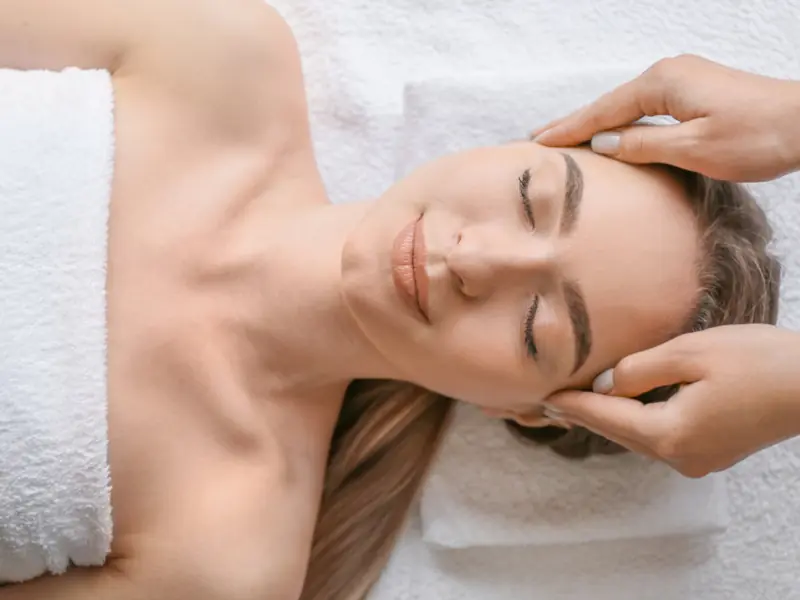
- The treatmentYou stay covered; only the area worked on is uncovered. You can talk, or not, and ask for more or less pressure at any point.
- The endYou are given a few minutes before getting up. Packing down is quick and the room goes back to how it was.
The questions nobody asks
| The question | The answer |
|---|---|
| Do I have to take everything off? | No. Keep what you want and stay covered. |
| What if the room is small? | Floor work on a mattress. Mention it when booking. |
| Do I have to talk? | No. Just say you would rather have quiet. |
| Can I stop partway? | Yes, at any point, without explaining why. |
| Male or female therapist? | State your preference: we confirm by availability. |
| Will the noise bother neighbours? | No. Music only if you want it, at low volume. |
What can go wrong, and what happens then
Three things come up regularly, and none is serious if anticipated. The first is access: in the medina the last stretch is on foot and addresses carry no numbers. Give the riad name and, if you have one, a landmark: a square, a gate, a shop.
The second is lateness. Marrakech traffic is unpredictable towards evening, and a therapist can arrive ten or fifteen minutes behind. You get a message rather than being left waiting with no news, and the treatment is never shortened to make up the time.
The third is the room itself: smaller than expected, a bed you cannot get around, air conditioning blowing straight onto the table. That is a one-minute fix on the spot, by moving to the floor or changing the orientation. Just say so rather than enduring an awkward position for an hour.
Frequently asked questions
Should I tip?
It is not expected and the quoted price stands on its own. Tipping is common in Morocco if you were happy, but nobody will make you feel either way about it.
How does payment work?
On the day, at the end of the treatment. No online payment and no card asked for when booking. The amount is confirmed before the appointment.
How much time should I allow in total?
The treatment length plus about thirty minutes for setup and packing down. For a sixty-minute treatment, allow an hour and a half start to finish.
Can we book for two different rooms?
Yes, back to back or in parallel depending on how many therapists are free for that slot. Mention it in the request: it is common for families and groups.